
One of my clients in Velachery was paying ₹10,000 a month on electricity. After we installed solar at his home, his last bill came to ₹200.
One thing I’ve noticed over Solar installs is that most people come to us already half-convinced.
They’ve seen a neighbour’s rooftop, or they’ve just paid another large TANGEDCO bill. The hesitation is usually about the process. Who handles what, how long it takes, and whether the subsidy actually comes through. That’s what this guide addresses.
If your bill has been climbing and you’ve been putting off the solar decision, here’s everything you actually need to know.
Quick summary:
Chennai gets 300+ sunny days, and so solar ROI is strong.
3kW system: ₹2.15L to ₹2.5L before subsidy, 3–5 year payback.
GLYDE installs within 15 days, and net metering is done within 30 days.
25-year panel warranty
Why are Chennai homes perfect for solar?
Chennai gets over 300 sunny days a year. That matters because solar panels generate power based on sunlight. More peak sun hours mean more units generated per kW of installed capacity.
A 3kW system in Chennai will outperform the same system in most other Indian cities.
The other factor is your electricity tariff. TANGEDCO charges residential consumers on a slab basis. The more units you consume, the higher your per-unit rate.
Once you cross 500 units a month, the rate jumps sharply. Most homes running ACs through Chennai’s 8-month summer are well past that threshold. Solar brings your billed units down, which pulls you into a lower slab and compounds the savings beyond just what your panels generate.
Across the 25+ homes we’ve installed in Chennai, the outcome is consistent: bills that used to run ₹3,000 to ₹10,000 a month drop to near zero. The ROI case in Chennai is one of the clearest I’ve seen anywhere in Tamil Nadu.
Which solar system is right for your home?
Most Chennai homes need an on-grid system.
Your panels generate power during the day, you use what you need, and the surplus flows back to TANGEDCO through net metering. The grid acts as your battery, no physical battery required, lower upfront cost, and it qualifies for the PM Surya Ghar government subsidy.
A hybrid system makes sense if you want power during outages. You get battery backup alongside grid connectivity. The cost goes up, but if your area sees frequent cuts, it’s worth considering.
Off-grid systems are rarely the right call for urban Chennai homes. Without grid connectivity, you’d need a battery bank large enough to cover your entire consumption, which gets expensive fast.
I only recommend off-grid for farms, sites without a TANGEDCO connection, or genuinely remote locations.
For most of the homes I’ve worked on in Chennai, an on-grid 3kW to 5kW system is the right answer. We’ve also done 10kW, 15kW, and 20kW systems for larger homes and villas. The sizing logic is the same; it just scales with your consumption.
How much solar cost in Chennai?
A 3kW on-grid solar system in Chennai typically runs between ₹2.15 lakh and ₹2.5 lakh. The actual number depends on panel brand, inverter quality, and rooftop complexity, which is why I always do a site visit before giving anyone a figure.
Not sure how many kW you need or what it’ll cost?
That’s exactly what our free site visit is for. We look at your roof and your bills, and give you a real number, not a range.
Call +91 70100 21773 or WhatsApp us.
When we quote a project at GLYDE, the price covers everything:
- Solar Panels
- Inverter
- Mounting Structure
- DC And AC Wiring
- Earthing
- Installation Labour, and
- Net Metering application to TANGEDCO.
There are no hidden add-ons after the project starts. You see the complete number upfront.
The central government’s PM Surya Ghar: Muft Bijli Yojana offers a direct subsidy for residential solar installations.
At Glyde, we handle all the documentation for this. You don’t fill out a single form. Once the system is commissioned and the commissioning certificate is issued, we track the process until the subsidy is credited directly to your bank account.
On a 3kW system, most Chennai homeowners are looking at a payback period of 3 to 5 years. After that, the power is essentially free for the remaining life of the panels, which is 25 years.
How we install it: From your first call to switch on
Here’s exactly what happens when you call Glyde.
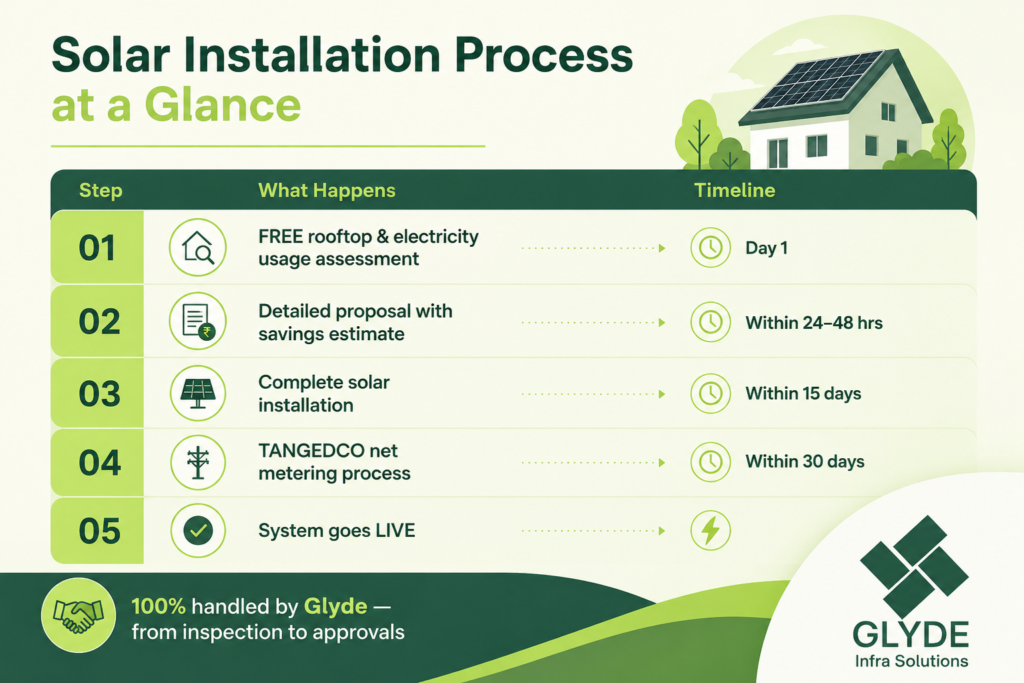
Site visit. We come to your home first. My team assesses your rooftop: usable area, shading, roof type, and orientation. We look at your last few electricity bills to understand your consumption pattern. This visit is FREE. Based on what we see, we tell you the system size that actually makes sense for your home.
System plan. We give you a detailed proposal: system size, number of panels, inverter spec, expected monthly generation, and expected bill reduction. You see the numbers before you commit to anything. If the numbers don’t make sense for your situation, I’ll tell you that too.
Execution. Once you sign off, we start immediately. Installation is done within 15 days, which includes panel mounting, inverter installation, wiring, earthing, and full system testing. We’ve worked on flat terraces, sloped tiles, and everything in between across Chennai neighbourhoods, so the team handles most rooftop conditions without surprises.
Net metering and handover. This is where most installers hand the homeowner a document file and say, “Good luck with the EB.” We don’t. Within 30 days of installation, we complete the entire TANGEDCO net metering process: every document, every inspection, every follow-up visit. When it’s done, your bidirectional meter is installed, and your system is fully live.
You call us, we handle everything from the rooftop to the running meter.
TANGEDCO, net metering, and all the EB paperwork: GLYDE handles it
Net metering is what makes on-grid solar genuinely worth it. When your panels generate more power than you’re using at that moment, the surplus flows back into the TANGEDCO grid and your meter runs backwards.
At the end of each billing cycle, you’re charged only for the net difference between what you consumed and what you exported. Most of our clients end up exporting more than they import on most months.
Getting net metering approved involves submitting an application to TANGEDCO, technical feasibility verification, a site inspection, coordination with the EB, and finally getting a bidirectional meter installed.
Each step has its own timeline and follow-up. Most homeowners who try to handle this themselves run into delays, and an incomplete document here, a missed inspection window there, and it drags on for months.
We take care of all of it.
From the moment you sign off on the project, you don’t deal with a single government office. We do it for you, and we get it done within 30 days.
Ready to go solar?
Get a free site assessment from GLYDE.
We’ll visit your rooftop, look at your bills, and tell you exactly what makes sense for your home.
Call +91 70100 21773 or WhatsApp us.
Frequently asked questions
1. How many solar panels do I need for a 3BHK in Chennai?
It depends on your consumption. Most 3BHK homes in Chennai use between 300 and 500 units a month. A 3kW system generates roughly 350 to 400 units a month in Chennai’s conditions, around 8 to 10 panels, depending on panel wattage. If you’re running ACs through summer and your consumption is on the higher end, a 4kW or 5kW system is more appropriate. We will look at your last few electricity bills during the site visit, and that tells us everything we need to size the system correctly.
2. How long does installation take?
From your first call to a fully commissioned, net-metered system: expect about 45 days. Installation itself takes 15 days. The remaining time is the TANGEDCO net metering process, which we manage and complete within 30 days. Some customers get it done faster, but 45 days is the honest timeline.
3. What warranty does Glyde offer?
25 years on the solar panels. Inverter warranty depends on the brand we specify, typically 5 to 10 years, and we tell you exactly what you’re getting before you agree to anything. Workmanship warranty covers any installation-related issues. If something isn’t right after we leave, we come back and fix it.
4. Do solar panels need maintenance?
Not much, and that’s genuinely one of the things I tell every client upfront. Solar panels have no moving parts. The main thing they need is occasional cleaning. Dust and bird droppings on the panel surface reduce output. In Chennai, once every 2 to 3 months is usually enough. The inverter has a small fan and needs clear airflow around it. Beyond that, the system runs on its own. We do a post-installation check once the system is live to confirm everything is generating correctly, and we’re reachable if anything looks off on the monitoring.