
The ads are everywhere. “Zero electricity bill with solar.” And if you’ve been paying ₹6,000 or ₹9,000 a month to TANGEDCO, it’s a hard claim to scroll past.
The full picture is more specific than the headline. For anyone researching a Chennai solar roof zero bill in 2026, here’s what the numbers actually look like, and what has to be true for that promise to hold.
| Quick Summary: Zero electricity bill with solar means ₹100–150, not ₹0. TANGEDCO’s fixed charge stays regardless. System size decides your savings: 3kW cuts 85–92%, 5kW gets you to 90–98%. Works best if your bill is above ₹4,000 and consumption is mostly daytime. Real result: a GLYDE customer went from ₹9,145 to ₹108 in January 2026. |
What The “Zero Bill” Ads Are Actually Saying (Net Metering, Plainly Explained)
The zero-bill claim runs on net metering. Once you understand how it works, the promise starts to make sense.
What is net metering?
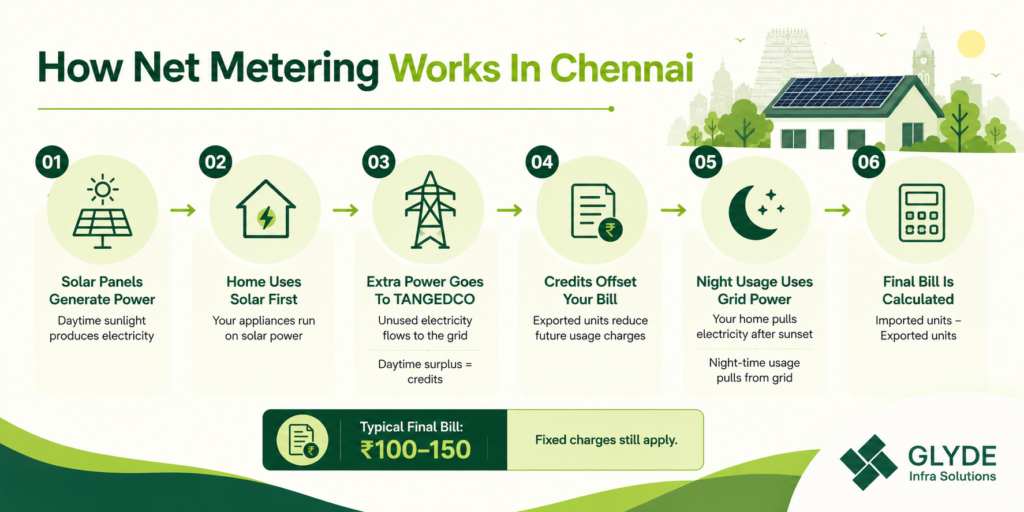
Net metering is a TANGEDCO billing arrangement that credits you for the surplus solar power you export to the grid.
Here’s how it works:
- Your solar panels generate power during daylight hours.
- When they produce more than your home is consuming at that moment, say midday when the AC is off and nobody’s home, the surplus flows into the TANGEDCO grid.
- Your bidirectional meter logs it as exported units.
- At the end of the billing cycle, TANGEDCO calculates the difference: units imported from the grid minus units exported. You pay for the net.
The TANGEDCO net metering application is what enables this. Once your bidirectional meter is installed and approved, that import-minus-export calculation happens automatically each billing cycle.
How much can solar reduce your bill?
In Chennai, where the sun delivers around 5.5 peak hours a day on average, a correctly sized system can reduce that net figure to near-zero through the summer months. TANGEDCO bills on a bi-monthly cycle, which means credits from high-generation months (roughly March through September, when irradiance peaks) roll forward to offset bills in the monsoon months and winter. Homeowners who’ve set this up correctly often see near-zero bills for most of the year, not just a few peak months.
What “zero electricity bill” actually means
The part most ads skip: TANGEDCO charges a small fixed minimum regardless of your consumption. Meter maintenance and grid connection fees don’t disappear even if your net consumption is zero. Expect ₹100–150 on your bill regardless of how well your system performs.
So when a solar company says “zero electricity bill,” they mean net consumption close to zero. For most Chennai homeowners, the bill lands at ₹100–150. Which, if you were paying ₹8,000 a month before, is close enough.
Also Read: Is Solar Worth It in 2026? A Homeowner’s Decision Guide
How Much Of Your Bill Solar Actually Covers (By System Size)
Chennai’s average solar irradiance runs around 5.5 peak sun hours a day, higher still in the April–June stretch. That figure directly determines how many units your panels generate each month.
- A 3kW rooftop system in Chennai generates roughly 420–450 units a month.
- A 5kW solar installation generates around 700–750 units.
What Affects Your System’s Output
These numbers assume south-facing panels with good sky exposure. Partial shading from a water tank, neighbouring building, or trees can reduce generation by 15–40%, depending on the severity, which is exactly why a proper site assessment is necessary before committing to a system size.
Panel orientation matters too. South-facing panels at a 10–15 degree tilt generate the most in Chennai. East or west-facing panels produce 10–20% less. If your terrace design requires a split orientation, a good installer will model the actual output before recommending a size, rather than applying a flat number from a brochure. A good solar panel installation in Chennai always starts with that site data: orientation, shading, roof area, and your actual consumption pattern.”
What This Means For Your Monthly Bill
If your monthly bill is around ₹4,000–5,000, you’re probably consuming 800–900 units. A 3kW system covers the bulk of that. A 5kW system covers it fully and exports surplus, which becomes credit against lower-generation months.
What Chennai homeowners typically see after installation:
- 2kW system: 70–80% bill reduction
- 3kW system: 85–92% bill reduction
- 5kW system: 90–98% bill reduction
Solar power savings in Chennai run higher than most cities in India because of TNEB’s upper-slab tariffs.
The remaining percentage is the fixed TANGEDCO charge plus any nighttime consumption. Without a battery, solar only powers your home when the panels are generating. The grid takes over at night, and those units still show up on your bill.
Savings By Monthly Bill: What To Expect
If you’re trying to determine which system size will help you achieve a near-zero solar bill in Chennai, this table is a good starting point. Numbers use the current TNEB domestic tariff slabs and Chennai irradiance data.
System costs already account for the PM Surya Ghar Yojana subsidy (up to ₹78,000 on a residential 3kW installation: ₹30,000/kW for the first 2kW, ₹18,000 for the third).
|
Monthly Bill |
Approx. Consumption |
Recommended System |
Estimated Savings |
Payback Period |
|---|---|---|---|---|
|
₹2,000 |
~600 units |
2 kW |
70–80% |
5–6 years |
|
₹9,000 |
~900 units |
3 kW |
85–90% |
4–5 years |
|
₹17,000 |
~1500 units |
5 kW |
90–95% |
4–5 years |
|
₹20,000+ |
~1800 units |
6–7 kW |
93–98% |
4–5 years |
The fastest way to reduce your electricity bill with solar in India is by matching system size to your actual consumption, not picking a standard package off a price list.
One more thing worth knowing about net metering credits: if your annual exports exceed your annual imports, TANGEDCO pays for the surplus units at the current approved rate. The credit doesn’t expire at year-end. This matters most for homeowners who size up slightly, generating more than they consume still has value; it doesn’t disappear.
The solar subsidy in Tamil Nadu in 2026 runs through the PM Surya Ghar Yojana. The PM Surya Ghar subsidy is available to residential homeowners who install through an MNRE-empanelled vendor and register on the pmsuryaghar.gov.in portal before installation. The subsidy arrives as a direct bank transfer after the system is commissioned and inspected. Processing typically takes 30–60 days post-installation.
When Zero Electricity Bill In Chennai Is Actually Possible
When you can expect near-zero:
- Your consumption is mostly daytime. ACs and appliances running while someone’s home is a load your panels cover directly as they generate. A 5kW or larger system sized to your actual consumption can push net monthly units to near-zero through Chennai’s peak sun months.
- You’ve got net metering active through TANGEDCO. The application typically takes 2–4 weeks to process after installation. Without it, surplus generation flows into the grid with no credit. Net metering is non-negotiable if you want the economics to hold.
- Your monthly bill is above ₹4,000. At that consumption level, a well-sized system has enough load to cover, surplus to export, and the numbers close in hard on zero.
When it probably won’t:
- Your bill is under ₹2,000. Solar will still cut it meaningfully, but TANGEDCO’s fixed charges mean ₹100–200 is the floor regardless of system size. Still worth doing, just not “zero.”
- Your heavy consumption runs at night. AC running after 10 pm, heavy night loads, those units come from the grid. A battery system handles this, though payback periods shift to 6–8 years depending on battery spec. Battery prices in India have been dropping; it’s a calculation worth running.
- Your terrace has real shading problems. Water tanks and adjacent buildings can shave enough off generation that the system sizing conversation has to start there, not with a standard package.
What GLYDE Customers In Chennai Are Actually Saving
For anyone wondering whether a Chennai solar roof zero bill is actually achievable or just ad copy: here’s a real TANGEDCO bill, not a projection.
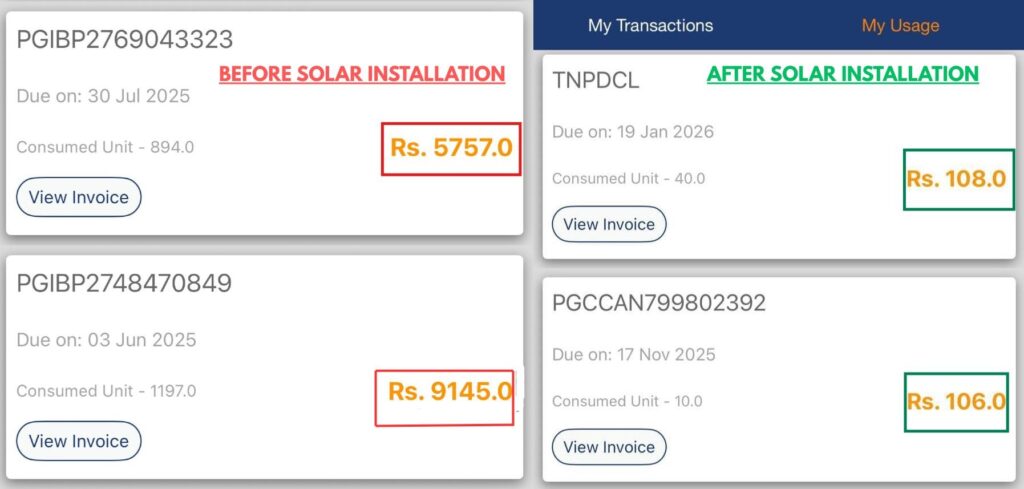
Before solar installation, this Chennai customer was paying ₹5,757 (894 units consumed) and ₹9,145 (1,197 units consumed) in consecutive billing periods. Peak summer, heavy AC use running through the day.
After their GLYDE rooftop system was commissioned:
- November 2025: ₹106. Consumption: 10 units.
- January 2026: ₹108. Consumption: 40 units.
The ₹106 is the TANGEDCO minimum fixed charge. Net consumption had dropped to single digits. A household spending close to ₹1 lakh a year on electricity is now paying roughly ₹1,200 a year, and that ₹1,200 is the grid connection fee, not actual energy consumption.
Results like this come from two things going right: the system is sized to actual consumption data (not a rough estimate), and the installation quality keeps generation losses minimal. Net metering needs to be active from the first billing cycle. The math isn’t complicated. Getting it right is the part that requires someone doing the site work properly, not just sell a package off a price list.
The Honest Answer On Chennai Solar Roof Zero Bill
For most Chennai homes paying above ₹4,000 a month, near-zero electricity bills with solar are genuinely achievable. A ₹100–150 TANGEDCO fixed charge stays on every bill, that’s the grid connection cost, and it doesn’t go away. Night-time consumption still comes from the grid unless you have a battery. The savings only hold when the system is sized and installed correctly.
₹108 instead of ₹9,145 is a real Chennai household’s January 2026 bill. That’s the actual answer to whether a Chennai solar roof zero bill is possible.
Want to know what your number looks like?
GLYDE does a free site visit and savings estimate. WhatsAppc or call us at 7010021773 to book one.
FAQs
1. Can I really get a zero electricity bill with solar in Chennai?
Close, but not exactly zero. TANGEDCO charges a small fixed minimum, usually ₹100–150, regardless of how much solar you generate. For most homeowners paying above ₹4,000 a month, a properly sized system gets your bill down to that fixed charge and nothing more.
2. What is net metering, and do I need it?
Net metering is what makes the savings work. It allows you to export surplus solar power back to the TANGEDCO grid and receive a credit for it. Without net metering active, you don’t earn those credits, and your bill won’t drop nearly as much. It’s non-negotiable; make sure it’s set up before your first billing cycle post-installation.
3. How long does it take to recover the cost of a solar system in Chennai?
Typically 4–5 years for most residential systems after the PM Surya Ghar subsidy. Chennai payback periods tend to be shorter than the national average because TNEB’s higher-slab tariffs mean each unit your system generates is worth more in savings.
4. What if my consumption mostly happens at night?
Solar only generates during daylight hours. Night-time consumption, AC running after 10 pm, appliances used late, still comes from the grid. A battery system can cover this, though it adds cost and shifts the payback period to around 6–8 years.
5. Does shading on my terrace affect how much I save?
Yes, significantly. Shading from a water tank, neighbouring building, or trees can drop generation by 15–40%, depending on how severe it is. This is exactly why a site assessment matters before choosing a system size. The right answer for a shaded terrace is different from the right answer for an open one.