
Key Takeaway:
PM Surya Ghar offers Chennai homeowners up to ₹78,000 in rooftop solar subsidy, capped at ₹30,000 each for the first two kW and ₹18,000 for the third. TANGEDCO handles approvals and net metering; full disbursal takes 8 to 12 weeks.
One caveat: PM Surya Ghar subsidy scheme is ending on 31 March 20217. Read more on this blog.
Chennai runs on electricity. The average independent house in the city burns through ₹4,000 to ₹10,000 on power every month. That number only moves in one direction.
Since February 2024, the central government has been paying homeowners up to ₹78,000 to put solar panels on their rooftops. Most Chennai homeowners have never claimed it.
Not because they’re ineligible. Not because the money isn’t real. The problem is that the application sits across two government portals, runs through three approval stages, and most installers don’t bother filing it for you.
This guide does what those installers don’t. You’ll see exactly what you’re entitled to, who qualifies, what documents to keep ready, how the dual-portal process runs in Chennai, and what’s new in 2026 that makes acting now the smarter call.
PM Surya Ghar Muft Bijli Yojana: What It Is And What You Actually Get
PM Surya Ghar Muft Bijli Yojana is the central scheme, launched in February 2024 and expanded through 2026. It’s the only active direct subsidy a Chennai homeowner can claim today.
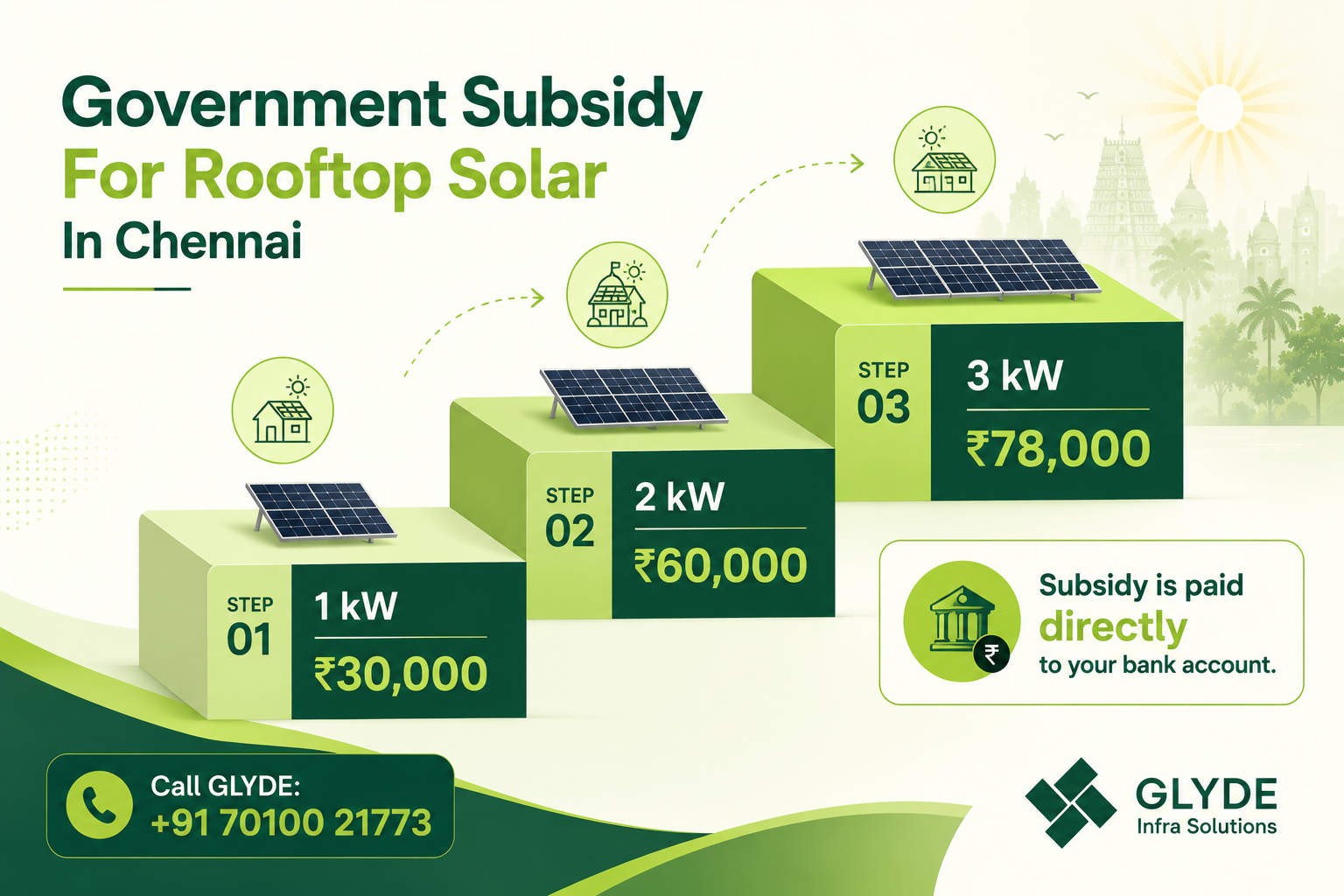
The math is straightforward:
- For the first kW: ₹30,000
- For the second kW: ₹30,000
- For the third kW: ₹18,000
- Anything above 3 kW: no additional subsidy
That caps the total at ₹78,000, paid directly into your bank account after installation and inspection. The 40% figure you’ll see in headlines applies cleanly to a 3 kW system. Go bigger, say a 5 kW or 8 kW setup, and the absolute subsidy stays at ₹78,000 while the percentage you recover drops.
| System Size | Subsidy Per kW | Total Subsidy |
|---|---|---|
| 1 kW | ₹30,000 | ₹30,000 |
| 2 kW | ₹30,000 | ₹60,000 |
| 3 kW | ₹30,000 for 1st–2nd kW, ₹18,000 for 3rd | ₹78,000 |
| 4 kW and above | Capped | ₹78,000 |
TANGEDCO’s Role: Net Metering, Approvals, And Subsidy Payout
Tamil Nadu does not currently run a separate state-level rooftop solar subsidy on top of PM Surya Ghar. As of 2026, the central scheme is what you’re claiming. The state’s job is to enable it.
TANGEDCO (now also called TNPDCL) does four things in the process.
Approves your installation through the Unified Solar Rooftop Portal (USRP).
Runs net metering, which credits your bill for surplus power you push to the grid.
Conducts the post-installation inspection.
Coordinates with the centre to release your subsidy.
Net metering is the part most homeowners underestimate. In Chennai, where your panels overproduce during long summer days, the exported units offset your night usage within the same billing cycle. The savings here often match the daytime self-consumption savings.
The state’s contribution sits in the net metering policy, which speeds up payback even without a separate subsidy on top.
Also Read: Is Solar Worth It in 2026? A Homeowner’s Decision Guide
Eligibility: Who Can Apply For The Subsidy
No income cap. No caste category requirement. No state-of-domicile restriction. If you meet the following conditions, the ₹78,000 is yours to claim.
You are eligible if:
- You are an Indian citizen aged 18 or above
- You hold an active residential electricity connection in your own name
- The property is yours, or you have written consent from the owner
- You have not previously claimed a rooftop solar subsidy under any government scheme
- Your electricity bill has no pending dues at the time of application
You are not eligible if:
- Your connection is registered as commercial or industrial
- The electricity connection is still in the previous owner’s name and hasn’t been transferred
- You are a tenant applying without the property owner’s involvement
| Category | Eligibility | What You Need To Know |
| Individual homeowner | ✅ Eligible | Connection must be in your name. If the property was recently purchased and the connection hasn’t been transferred yet, get the transfer done before applying. A mismatched name between property documents and the electricity bill is one of the most common reasons applications stall. |
| Applicant with property in a parent’s or relative’s name | ✅ Eligible with conditions | You can apply, but you must attach a written consent letter from the property owner along with a copy of their ID. Without this, the feasibility stage will flag a document mismatch and send you back. |
| Apartment flat owner (individual) | ✅ Eligible | Applies to your individual unit’s connection. The system would typically go on your exclusive terrace space if available. For shared rooftop access, the housing society route (below) is the correct path. |
| Housing society or RWA | ✅ Eligible | Subsidy is ₹18,000 per kW for common-area installations up to 500 kW. The association files the application, not individual flat owners, and a board resolution authorising the installation is required. This is how most Chennai apartment complexes have gone solar in the last 18 months. |
| Tenant | ❌ Not eligible | The subsidy requires the electricity connection to be in the applicant’s name. A tenant cannot apply independently. The property owner would need to initiate and own the application. |
| Commercial or industrial connection holder | ❌ Not eligible | PM Surya Ghar is a residential scheme. Commercial and industrial setups do not qualify for this subsidy, though separate net metering and accelerated depreciation benefits apply under different MNRE programmes. |
| Previous subsidy claimant | ❌ Not eligible | If you have claimed a rooftop solar subsidy under any prior government scheme — central or state — you cannot claim PM Surya Ghar. There is no exception to this condition. |
Documents You’ll Need
Keep these in one folder before you start. The portal times out if you take too long uploading.
- Aadhaar card (linked to your registered mobile number)
- The latest electricity bill for the last two months
- Property ownership proof: sale deed, patta, or municipal tax receipt
- Bank account passbook or cancelled cheque (the subsidy lands here directly)
- Passport-size photograph
- Two or three roof photos showing the proposed installation area
If you’re applying on behalf of a parent or relative, add a written consent letter and a copy of their ID. The portal accepts only JPG or PDF files, each under 2 MB.
Also Read: Is the PM Surya Ghar subsidy scheme ending in March 2027
How To Apply For A Solar Subsidy Online: Step-By-Step
This is where most homeowners stall. The flow runs across two portals with at least four wait periods. Here’s the actual sequence.
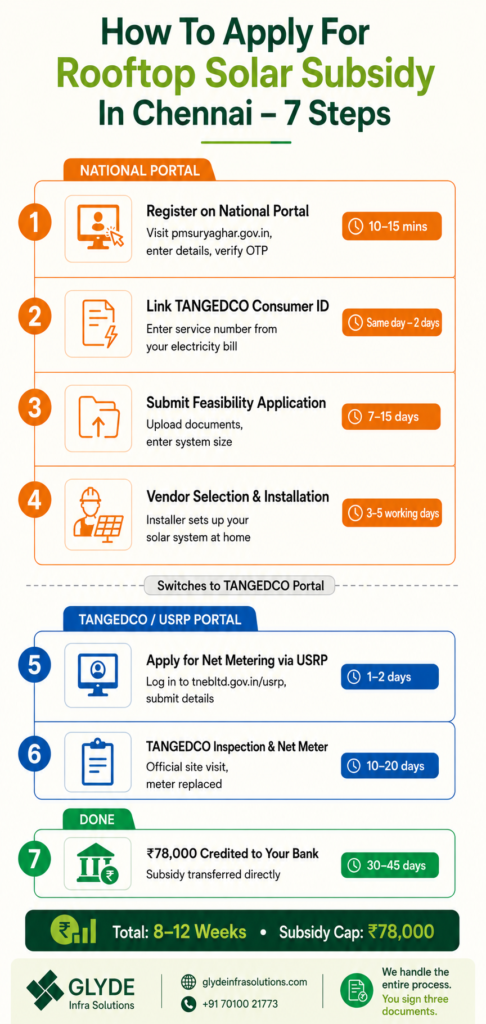
Step 1: Register On The National Portal
Visit pmsuryaghar.gov.in and click “Apply for Rooftop Solar.” Enter your state (Tamil Nadu), district (Chennai), and DISCOM (TANGEDCO). Use your registered mobile number to create the account. You’ll get an OTP, followed by a consumer ID prompt.
Time: 10 to 15 minutes if your documents are ready.
Step 2: Link Your DISCOM Consumer ID
Enter your electricity service number exactly as it appears on your TANGEDCO bill. The portal pulls your sanctioned load automatically. If the linkage fails, call your local TANGEDCO section office and request a meter detail update.
Time: Same day to two days for any correction.
Step 3: Submit Your Feasibility Application
Fill in the proposed solar capacity. Upload your documents. Submit. TANGEDCO then conducts a technical feasibility check, typically within 7 to 15 days, to confirm your roof and electrical infrastructure can support the system.
Step 4: Choose A Vendor And Get The Installation Done
Once feasibility is approved, the portal unlocks the vendor selection stage. This is where installation partners who are MNRE and TEDA-empanelled enter the picture. They handle system design, equipment sourcing (DCR and ALMM-compliant), physical installation, and inverter commissioning. Getting this step right matters: an incorrectly empanelled vendor disqualifies your subsidy entirely.
Typical installation time for a 3 kW system in Chennai: 3 to 5 working days after material delivery.
Step 5: Apply For Net Metering Through TANGEDCO’s USRP
Once the system is installed, log in to the the TNPDCL- USRP website. Submit installation details, inverter and panel serial numbers, and pay the meter and inspection charges. TANGEDCO will schedule a site inspection.
Inspection wait time: 10 to 20 days in Chennai, depending on the section office workload.
Step 6: Net Metering Installation And Commissioning
After inspection, TANGEDCO replaces your existing meter with a bidirectional net meter. Your system goes live the same day.
Step 7: Subsidy Disbursal
Once commissioning is recorded on the national portal, your subsidy gets credited to your linked bank account within 30 to 45 days.
Total elapsed time, start to subsidy: 8 to 12 weeks for most Chennai households.
Don’t want to manage this yourself?
GLYDE handles the entire dual-portal process for Chennai homeowners, including registration, feasibility submission, vendor coordination, USRP filing, and TANGEDCO follow-ups. You stay informed at every stage without touching a single portal.
WhatsApp us now or call us at 70100 21773!
Why Is My Solar Subsidy Not Approved?
A short list of what slows applications down in Chennai, based on what we see most often:
- Service number entered with a typo or extra spaces copied from the bill.
- Aadhaar mobile number might be outdated, so the OTP never lands.
- Property document mismatch. Usually, a patta in a parent’s name is without consent paperwork attached.
- Roof photos that don’t show the full proposed installation area, forcing a re-upload after the feasibility check.
- Bank account in a joint name where the primary holder isn’t the applicant.
Each of these adds two to four weeks to your timeline. Most are 5-minute fixes if caught before submission.
At GLYDE, we review every document and cross-check every detail before anything is submitted. In two years of handling Chennai subsidy applications, none of our clients has had an application rejected for a documentation error.
Talk to us before you apply → 70100 21773
Picking The Right Solar Power System Size For Your Home
A 1 kW system suits a small flat with a monthly bill under ₹1,500 and produces around 4 units a day in Chennai.
A 2 kW system fits a 2-BHK running ACs in two rooms, with bills around ₹2,500 to ₹3,500 a month, producing 8 to 9 units daily.
A 3 kW system is the sweet spot for most independent houses in Chennai. It covers a 3-BHK with ACs, a refrigerator, and the usual evening load — and maxes out your subsidy. Anything above 3 kW makes financial sense only if your roof area and load profile justify it, since the per-kW subsidy stops scaling.
Financing Options If You Can’t Pay Upfront
The subsidy reduces your cost, but you still have to fund the installation first. The ₹78,000 arrives after commissioning, not before. For homeowners who can’t or don’t want to pay the full amount upfront, there’s a structured financing route worth knowing about.
NABARD Solar Refinance Scheme: Extended through September 2026, this scheme allows homeowners to take a solar loan from participating banks at concessional interest rates. Participating lenders include district cooperative banks, regional rural banks, and small finance banks. The process:
- Identify a participating lender in Chennai.
- Apply for a solar loan with standard KYC documents, property proof, and a quotation from an empanelled installer.
- Install the system and simultaneously apply for the PM Surya Ghar subsidy.
- Once the subsidy is credited, it is adjusted against your outstanding loan balance, reducing what you owe rather than sitting in your account.
This means you can go solar without tying up your savings, and the government subsidy effectively pays down part of your loan automatically. If upfront cost is what’s been holding you back, this route removes that barrier entirely.
If you’re unsure which Chennai lenders are currently active under NABARD’s scheme, or how the subsidy-against-loan adjustment works in practice, speak to us. We’ve helped clients navigate this route alongside the full installation and subsidy process.
What Glyde Does So You Don’t Have To
The application process is doable. It’s also time-consuming, and a single error on document upload, vendor selection, or system specification can push your timeline back by weeks.
Glyde Infra Solutions is MSME-registered and works under full TANGEDCO and TEDA compliance. We’ve handled the dual-portal flow for residential clients across Chennai, including document preparation, MNRE vendor coordination, USRP submission, and direct follow-up with section offices when inspection timelines slip.
When you work with us:
- Free site survey at your Chennai property, including shadow mapping and roof assessment.
- Full subsidy paperwork prepared and submitted on your behalf, at no additional charge.
- DCR and ALMM-compliant equipment, supplied and installed by our team.
- Coordination with TANGEDCO for inspection, net metering, and commissioning.
- Complete handover with your subsidy reference number and live tracking link.
You sign three documents. We handle the rest.
WhatsApp us to book your free rooftop assessment now!
FAQs
1. Can a tenant apply for the rooftop solar subsidy?
No. The subsidy requires the electricity connection to be in the applicant’s name. Tenants cannot apply independently. The property owner must file the application and own the system. A tenant can benefit from lower bills through an arrangement with the owner, but cannot claim the subsidy directly.
2. Can an NRI apply for the subsidy on their Chennai property?
Not directly. The portal requires Aadhaar-linked OTP verification, which most NRIs can’t complete independently. A resident family member with a valid power of attorney can apply on the property’s behalf, though the subsidy gets credited to their Indian bank account, not an overseas one.
3. What is DCR and ALMM compliance, and why does it matter for your subsidy?
DCR (Domestic Content Requirement) means solar panels must be manufactured in India. ALMM (Approved List of Models and Manufacturers) is the central government’s quality-verified panel list. Your installation must use panels from this list for the subsidy to be approved. Always confirm your installer is sourcing ALMM-listed panels before signing.
4. What should I do if TANGEDCO’s inspection takes significantly longer than the stated timeline?
If your inspection isn’t scheduled within 25 days, visit your local TANGEDCO section office in person with your USRP application reference number and request a specific date. In-person follow-ups move significantly faster than emails or calls in most Chennai section offices.
5. Can I claim the subsidy if I already have solar panels installed?
No. PM Surya Ghar covers only new installations registered through pmsuryaghar.gov.in after February 2024. Systems installed before the scheme launched, or installed without going through the portal’s approval process, are not eligible. There is no retroactive claim route under any circumstances.
6. Does the subsidy apply to hybrid or off-grid solar systems?
Only partially. Hybrid systems with battery storage are allowed, but only the solar component qualifies for the subsidy; battery costs are excluded. Pure off-grid systems with no TANGEDCO grid connection are not eligible at all. The scheme covers on-grid installations only.
For newest news you have to pay a visit the web and on the web I found this web page as a best site for most recent updates.
It is truly a great and useful piece of information. I’m happy that you shared this useful information with us. Please keep us up to date like this. Thanks for sharing.
I have recieved the national subsidy today ,will I get the Tamil Nadu state governments additional subsidy of 22 thousand also?
HI Meena,
Unfortunately, once you receive the subsidy, you won’t be able to apply for the 22,000. This new subsidy scheme applies to those who applied on the PM Surya Ghar portal after the 2nd week of September.
For any other query, please contact us at 7010021773.