
On-grid solar works alongside the grid to cut your electricity bill, off-grid solar runs independently on batteries, and hybrid solar combines solar, batteries, and the grid for backup. For most grid-connected Chennai homes, on-grid is the usual starting point.
Key Takeaways
- The core difference in on-grid vs off-grid solar is backup, since a standard on-grid system shuts down with the grid while off-grid and hybrid systems keep running.
- Because batteries add cost, sizing decisions, and eventual replacement, on-grid stays the simplest system while hybrid and off-grid demand more planning.
- Tamil Nadu’s combined central and state rooftop solar subsidy can apply to eligible on-grid systems, and possibly grid-connected hybrid systems, but never to off-grid.
- Matching the system to your consumption, backup needs, and subsidy eligibility, not roof size, lets you pay only for what your home actually needs.
Introduction
Every solar quote comes with a question nobody prepared you for: on-grid, off-grid, or hybrid? Nobody explains it properly, and picking the wrong one can mean paying for batteries you never needed, or having no backup when you do.
If you have been searching on-grid vs off-grid solar late at night, trying to work out the difference, you are not alone. This guide compares solar off-grid vs on-grid in plain language and covers the hybrid option too.
For most grid-connected homes in Chennai, an on-grid system is the usual starting point. It is the simplest configuration, and it can qualify for the Tamil Nadu rooftop solar subsidy of up to ₹1,00,000 for systems of 3kW and above (₹78,000 from the central government plus ₹22,000 from the Tamil Nadu government). Off-grid systems do not qualify for the subsidy.
If you are still deciding whether solar makes sense for your home, see GLYDE’s guide on whether solar is worth it for Tamil Nadu homes.
On-Grid vs Hybrid vs Off-Grid Solar: At A Glance
| Feature | On-Grid Solar | Off-Grid Solar | Hybrid Solar |
|---|---|---|---|
| Main purpose | Reduce grid electricity use | Energy independence | Solar plus battery backup |
| Connected to the electricity grid | Yes | No | Yes |
| Solar panels | Yes | Yes | Yes |
| Battery storage | Usually not required | Required | Required |
| Uses grid electricity | Yes | No | Yes, when required |
| Stores excess solar energy | No, surplus is exported to the grid | Yes, in batteries | Yes, in batteries |
| Rooftop solar subsidy (central + Tamil Nadu) | Yes, up to ₹1,00,000 for 3kW and above | No | Can apply for eligible grid-connected systems; confirm with GLYDE |
| Upfront cost | Lowest of the three | Higher, batteries required | Higher, battery and hybrid inverter required |
| System complexity | Simplest | Most demanding | Moderate |
| Suitable for remote locations | Generally no | Yes | Sometimes |
| Best for | Reliable grid, lower electricity bills | No grid access, or full independence | Bill savings plus power cut backup |
Thinking about solar for your Chennai home?
GLYDE Infra Solutions can assess your electricity usage, roof, backup requirements, and preferred system type before recommending a configuration. Message GLYDE on WhatsApp to get started.
What Is an On-Grid Solar System?
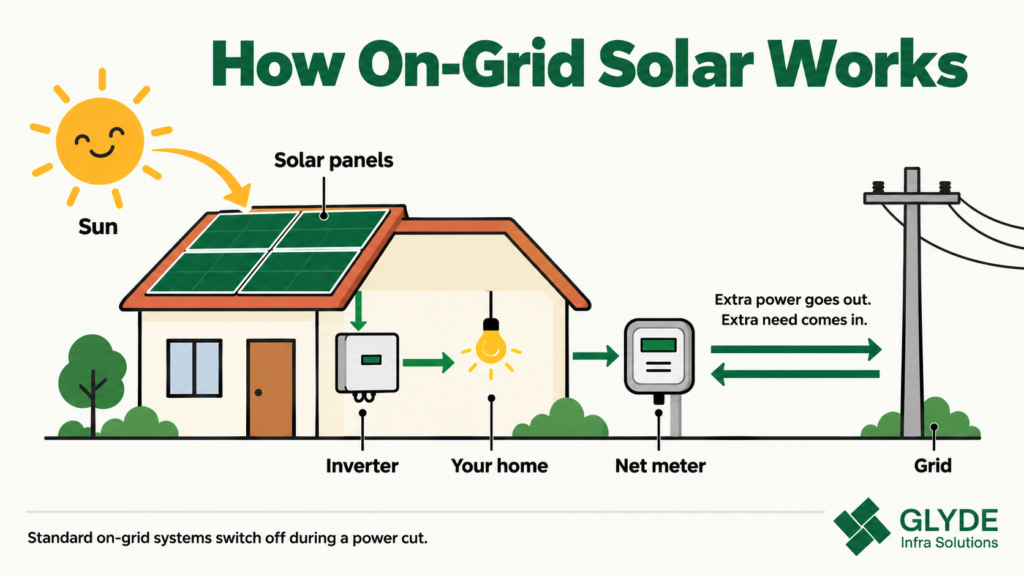
An on-grid solar system is a rooftop solar setup that works alongside the electricity grid. Your panels power your home during the day; any surplus is exported to the grid through a net meter, and you draw from the grid when solar falls short. It usually needs no battery, but it shuts off during a power cut.
How does an on-grid solar system work?
During the day, your solar panels generate DC electricity, and the inverter converts it into AC electricity for your home.
Your appliances use solar electricity first. If generation exceeds your immediate consumption, the surplus is exported to the grid under net metering, where TNPDCL (earlier TANGEDCO) installs a bidirectional meter that records what you import and export. When solar generation is insufficient, your home draws electricity from the grid.
Does an on-grid solar system work during a power cut?
No. A standard on-grid solar system stops supplying your home when the grid goes down, even in bright sunlight. The reason is a safety feature called anti-islanding.
With anti-islanding, the inverter continuously monitors the grid’s voltage and frequency. If the grid fails, the inverter switches off within seconds. Without this, your panels could keep pushing electricity into lines that utility workers believe are dead, which could injure them. Grid-connected inverters also rely on the grid as a reference signal to operate, so without a battery or another source to provide one, they have nothing to sync with.
If you want power during cuts, you need a hybrid system. Its inverter isolates your home from the grid during an outage and runs your chosen loads from the battery, so the safety rule is still respected.
Is an on-grid system eligible for the New solar subsidy?
Yes. On-grid systems are the most straightforward fit for the PM Surya Ghar subsidy and the Tamil Nadu state top-up. A 3kW on-grid system can receive up to ₹78,000 from the central government plus up to ₹22,000 from the Tamil Nadu government, which is up to ₹1,00,000 in total. See the subsidy section below for the full breakdown.
Who should consider an on-grid solar system?
An on-grid system suits a home that:
- Has a reliable grid connection
- Primarily wants to reduce electricity bills
- Has useful daytime electricity consumption
- Does not need solar-powered backup during outages
- Wants a relatively straightforward solar configuration
- Wants to claim the rooftop solar subsidy
What Is an Off-Grid Solar System?
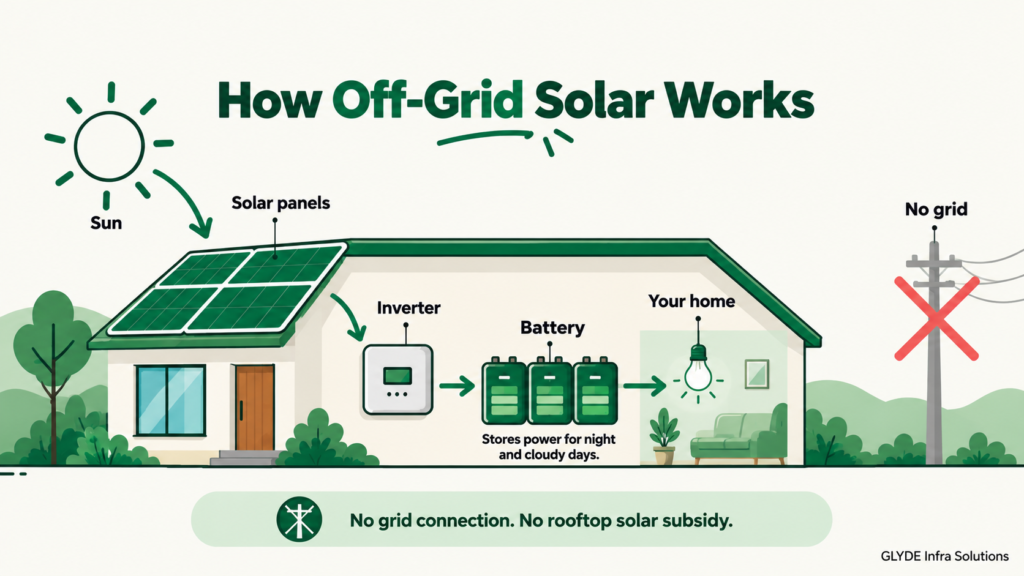
An off-grid solar system is a solar setup that runs completely independently of the electricity grid. Solar panels generate power during the day, and batteries store it for nights and cloudy spells. Because there is no grid to fall back on, it needs batteries and careful sizing, and it does not qualify for the rooftop solar subsidy.
How does an off-grid solar system work?
Solar electricity powers your appliances and charges the batteries during the day. At night or during low solar generation, stored battery energy supplies the home.
Because there is no grid to fall back on, the panels, inverter, battery capacity, and energy management need to be designed around your actual electricity consumption.
Why does an off-grid system need batteries?
Battery storage is central to an off-grid system. Your home needs electricity after sunset, when solar panels are not generating, and cloudy weather can also reduce generation.
Battery capacity must match your consumption. A home running basic load has very different requirements from one using air conditioners, refrigerators, pumps, and other high-consumption appliances. Lithium batteries usually cost more upfront but tend to last longer than lead-acid batteries.
Is an off-grid system eligible for the solar subsidy?
No. The rooftop solar subsidy is not available for off-grid systems. If you choose off-grid, you pay the full system cost yourself.
Who should consider an off-grid solar system?
An off-grid system may suit a property where:
- Reliable grid access is unavailable
- The owner wants full energy independence
- Battery storage and its replacement cost are acceptable
- Electricity consumption can be matched to available solar and storage
- The property is remote, such as a farmhouse
For a typical urban home with a dependable grid connection, going completely off-grid is rarely necessary.
What Is a Hybrid Solar System?
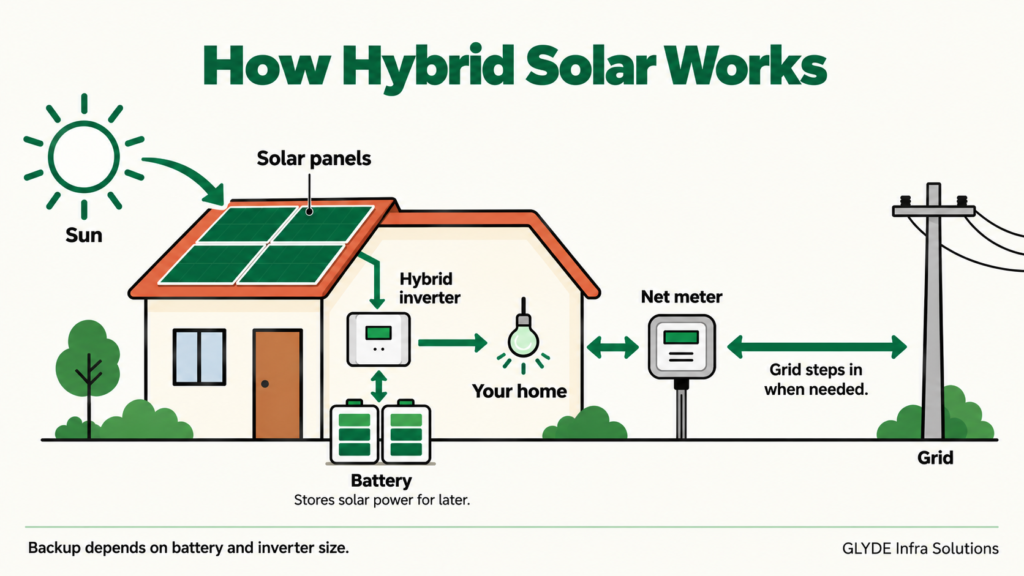
A hybrid solar system is a rooftop solar setup that combines solar panels, a battery, and a grid connection. Your panels power your home and charge the battery, and the grid steps in when both fall short. Unlike a standard on-grid system, it can keep your chosen appliances running during a power cut, as long as the battery has charge
How does a hybrid solar system work?
During the day, solar energy powers your home and can charge the battery, depending on the system’s configuration. When solar generation is insufficient, stored battery energy can supply designated loads. If solar and stored energy are both insufficient, the system draws electricity from the grid.
The exact sequence depends on the inverter, battery, settings, and system design.
What happens when there is a power cut?
A suitably configured hybrid system provides backup during a grid outage. That does not mean every appliance in your home keeps running. Backup depends on battery capacity, inverter capacity, connected circuits, and the appliances you want to operate.
For example, a Chennai household may choose to back up lights, fans, Wi-Fi, and a refrigerator rather than every high-consumption appliance.
Is a hybrid system eligible for the solar subsidy?
A hybrid system stays connected to the grid, so it can apply for the rooftop solar subsidy, subject to the scheme’s eligibility conditions. Ask GLYDE how your specific configuration is treated before you finalise the design.
Who should consider a hybrid solar system?
A hybrid system suits a home that:
- Wants solar generation and battery backup
- Experiences inconvenient power cuts
- Wants to remain connected to the grid
- Wants to store solar energy for later
- Needs more flexibility than a standard on-grid system
Not sure whether you need an on-grid or hybrid setup? Don’t choose a system based only on the number of panels that fit on your roof. Talk to GLYDE on WhatsApp about your electricity usage and backup requirements.
On-Grid vs Off-Grid vs Hybrid Solar: Which One Should You Choose?
There is no single solar system that is right for every home in Chennai or Tamil Nadu. A homeowner in Chennai with a reliable grid connection has very different needs from someone installing solar at a farmhouse or remote property. Choose based on what you want your solar installation to achieve.
Choose on-grid solar if your main goal is reducing electricity bills
If you have a reliable grid connection and your primary goal is reducing the electricity you buy from the grid, an on-grid solar system is usually the right fit.
Consider it if:
- Your grid connection is reliable
- Reducing electricity costs is your priority
- You don’t need battery backup
- You want a simple configuration with the lowest upfront cost
- You want to claim the subsidy
- You have useful daytime electricity consumption
You may not need battery storage simply because you are installing solar.
Choose hybrid solar if you want bill savings plus backup
A hybrid solar system suits homeowners who want solar generation, battery storage, and continued access to the grid. It is the system to discuss if your home faces frequent or inconvenient power cuts.
Don’t assume that any rooftop solar system keeps your home running during an outage. A standard on-grid system disconnects when the grid goes down. Tell your installer which appliances you want to run during an outage and for how long, so the battery and inverter can be sized accordingly. A Chennai household might choose fans, lights, Wi-Fi equipment, and a refrigerator.
Consider it if:
- You want battery backup during power cuts
- You want to use stored solar energy after sunset
- Your home remains connected to the grid
- You want more flexibility than a standard on-grid system provides
The important thing is not to choose a system simply because it sounds more advanced. Choose the configuration that solves the specific electricity problem you have at home.
Choose off-grid solar if you need to operate independently
An off-grid solar system suits remote homes, farmhouses, agricultural properties, or locations where dependable grid access is difficult to obtain. Battery storage is particularly important because electricity is needed after sunset.
Consider it if:
- Reliable grid access is unavailable
- You want to operate independently
- You are prepared to use and eventually replace batteries
- Your consumption can be planned around solar and stored energy
- You accept that no subsidy is available
What to check before you decide
Before choosing between on-grid, off-grid, and hybrid solar, work through this list:
- Monthly electricity consumption
- When your home uses the most electricity
- How many hours of power cut you get, and how often
- Which appliances need backup and for how long
- How much battery storage that backup would require
- Whether you want to claim the subsidy
- Your budget and long-term energy requirements
A good solar installation is designed around how your home actually consumes electricity, not around the largest system that fits on the roof.
Get a system designed around your home, not a generic package. GLYDE Infra Solutions serves homeowners across Tamil Nadu and can help assess your electricity usage, roof, and backup requirements. Book a call with GLYDE.
Solar Subsidy in Tamil Nadu: Which System Qualifies?
Tamil Nadu homeowners can combine two subsidies on eligible rooftop solar systems: the central PM Surya Ghar Muft Bijli Yojana subsidy and the Tamil Nadu state top-up. Together, they can reach up to ₹1,00,000 for systems of 3kW and above.
| System capacity | Central subsidy (PM Surya Ghar) | Tamil Nadu state top-up | Combined subsidy |
|---|---|---|---|
| 1 kW | Up to ₹30,000 | Up to ₹5,000 | Up to ₹35,000 |
| 2 kW | Up to ₹60,000 | Up to ₹10,000 | Up to ₹70,000 |
| 3 kW and above | Up to ₹78,000 | Up to ₹22,000 | Up to ₹1,00,000 |
The full ₹1,00,000 applies only to systems of 3kW and above. Smaller systems receive proportionally less.
Which system types qualify:
- On-grid solar: Eligible, subject to the scheme’s conditions.
- Hybrid solar: Can apply for eligible grid-connected systems. Confirm how your configuration is treated.
- Off-grid solar: Not eligible. No subsidy is available.
This is one reason on-grid is the usual starting point for a grid-connected Chennai home. The subsidy lowers your net cost, and you can add battery backup later if power cuts become a problem.
Eligibility conditions apply. Generally, the scheme is for residential consumers with an electricity connection in their own name, and the installation must use compliant equipment. Subsidy amounts, conditions, and timelines can change, so confirm current terms before you apply.
Also Read: GLYDE’s step-by-step guide to the rooftop solar subsidy in Chennai explains the application process.
On-Grid Solar Cost vs Off-Grid Solar Cost vs Hybrid Solar Cost
Comparing the cost of an on-grid vs off-grid solar system isn’t simply a comparison of panel prices. Different configurations need different components, and the final cost depends on system capacity, inverter type, battery capacity, roof structure, installation requirements, and the loads you want to support.
| System | Typical components | Approximate cost (3kW home system) | Subsidy |
|---|---|---|---|
| On-grid | Solar panels, inverter, mounting structures, electrical components, installation and commissioning | Around ₹2,05,000 | Up to ₹1,00,000 |
| Off-grid | Solar panels, batteries, off-grid inverter or inverter-charger, protection equipment, mounting structures, installation and commissioning | Around ₹2,20,000 | Not available |
| Hybrid | Solar panels, hybrid inverter, battery storage, mounting and electrical equipment, installation and commissioning | Around 3,15,000 | Can apply for eligible grid-connected systems |
Because batteries and hybrid equipment add components, off-grid and hybrid systems cost more upfront than a basic on-grid installation. Off-grid systems also lose the subsidy, which widens the gap further.
For a view of how quickly an on-grid system can pay for itself in Chennai, see GLYDE’s guide on the payback period for a Chennai home.
Before getting a quotation, ask the installer to specify the solar capacity, inverter, battery capacity if applicable, backup loads, warranty terms, and subsidy handling, so you can compare quotations like for like.
Final Thoughts
Choosing between on-grid vs off-grid solar is ultimately a question of how you want your home to use and store electricity.
- On-grid solar is connected to the grid and focuses on using solar generation to reduce grid electricity consumption. It is the simplest option and qualifies for a subsidy of up to ₹1,00,000 on 3kW and above.
- Off-grid solar operates independently and relies on battery storage. It suits remote properties, and no subsidy is available.
- Hybrid solar combines solar, battery storage, and grid connectivity for homeowners who want both bill savings and backup.
For homeowners in Chennai and across Tamil Nadu, the right system depends on electricity consumption, grid reliability, backup requirements, roof conditions, and whether you want to claim the subsidy.
If you’re unsure which configuration fits your home, GLYDE Infra Solutions can help you evaluate your requirements before you commit to a system.
Ready to explore solar for your home in Tamil Nadu? Message GLYDE on WhatsApp or visit the GLYDE contact page to discuss the right configuration for your property.
Frequently Asked Questions
What is the difference between on-grid and off-grid solar?
An on-grid solar system remains connected to the electricity grid and uses the grid when solar generation is insufficient. An off-grid system operates independently and relies on solar generation and battery storage.
Which is better, on-grid or off-grid solar?
Neither system is universally better. An on-grid system suits a grid-connected home that wants to reduce electricity bills and claim the subsidy. An off-grid system suits properties that need to operate independently, without grid access.
What is the difference between on-grid, off-grid and hybrid solar?
An on-grid system uses solar alongside the electricity grid, an off-grid system operates independently using solar and battery storage, and a hybrid system combines solar, battery storage, and grid connectivity.
Is a subsidy available for on-grid, off-grid, and hybrid solar in Tamil Nadu?
Subsidy is available for eligible on-grid systems and can apply to eligible grid-connected hybrid systems. It is not available for off-grid systems. Confirm how your configuration is treated before you finalise the design.
How much solar subsidy can I get in Tamil Nadu?
Eligible homes can get up to ₹78,000 from the central government under PM Surya Ghar and up to ₹22,000 from the Tamil Nadu government, which is up to ₹1,00,000 in total for systems of 3kW and above. Smaller systems receive less. Read GLYDE’s guide to the rooftop solar subsidy in Chennai for the application steps.
Does an off-grid solar system need a battery?
Yes. Battery storage is a key component of a typical off-grid system because the property cannot rely on the grid when solar generation is unavailable.
Does a hybrid solar system work during power cuts?
A suitably configured hybrid solar system provides backup during a grid outage using battery storage. Backup depends on the inverter, battery capacity, connected loads, and overall system design.
Which solar system is suitable for a home with frequent power cuts?
If you want solar generation as well as backup during power cuts, a suitably designed hybrid solar system is worth considering. The battery and inverter should be sized according to the appliances you want to keep running.