
| Short answer: Yes. The PM Surya Ghar Muft Bijli Yojana closes on 31 March 2027. There is no confirmed extension. The ₹78,000 subsidy and the current loan structure are tied to this deadline. |
You’ve probably seen the forward already. “Solar subsidy ending soon, apply before March or lose ₹78,000!” It’s been doing the rounds on every family group since early 2026.
The PM Surya Ghar Muft Bijli Yojana is still active. Applications are being processed. The ₹78,000 subsidy is real and available right now. But the scheme has a confirmed close date: 31 March 2027. The official portal shows a live countdown. As of 30 June 2026, that’s 273 days.
No confirmed extension. No replacement scheme announced yet.
If you’re a homeowner in Tamil Nadu who’s been wondering if rooftop solar in Chennai is necessary, read this before you wait any longer.
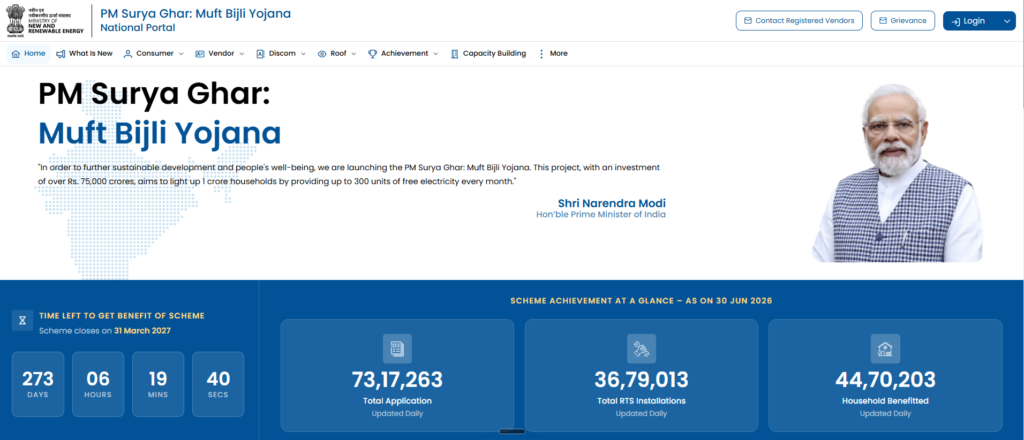
Source: pmsuryaghar.gov.in
What does the PM Surya Ghar Scheme closing in March 2027 mean for you?
Most people read “scheme closing” and assume the government is pulling the plug on solar subsidies forever. That’s not what’s happening. Here’s the accurate version.
The PM Surya Ghar Muft Bijli Yojana was approved with a specific budget of ₹75,021 crore, tied to a specific target: 1 crore rooftop solar installations by FY 2026-27. March 2027 is when that implementation period ends.
Once it ends, one of two things happens:
- The government announces a new scheme with its own terms, subsidy rates, and budget. Those terms may be better, worse, or simply different from what exists today.
- There’s a gap with no active residential rooftop solar subsidy until a new scheme is notified.
Neither outcome is confirmed. What is confirmed is that the ₹78,000 subsidy, the collateral-free loan at 7%, and the Direct Benefit Transfer structure you can claim today are all tied to this scheme and this deadline.
The risk isn’t that solar stops being viable after March 2027. Solar without subsidy still makes financial sense in Chennai, given TANGEDCO’s tariff trajectory. The risk is that you pay ₹78,000 more for the same system than someone who applied six months earlier.
PM Surya Ghar deadline in Tamil Nadu: Does March 2027 actually affect you?
If your electricity bill is climbing every quarter and you’ve been thinking about solar, March 2027 changes the math significantly.
Here’s the simple version. Right now, the government pays ₹78,000 toward a rooftop solar system that could bring your TANGEDCO bill close to zero. Chennai gets approximately 5.3 peak sun hours a day. A 3kW system generates enough electricity to cover 70 to 100% of a typical household’s consumption. After March 2027, that ₹78,000 is gone with no confirmed replacement.
Solar subsidy process in Chennai takes longer than you think
From the day you register on pmsuryaghar.gov.in to the day the subsidy hits your bank account, the realistic timeline in Tamil Nadu is 60 to 90 days. It breaks down like this:
- TANGEDCO feasibility approval: 15 to 30 days
- Vendor procurement and installation: 1 to 2 weeks
- Net metering inspection and commissioning: 15 to 30 days
- Subsidy credit after commissioning: 30 to 45 working days
Start in January 2027, and you’re cutting it very fine. Start in November 2026, and you have enough buffer for one round of delays without losing the subsidy.
The final months will be a rush
Every government scheme sees a surge in applications as the deadline approaches. PM Surya Ghar won’t be different.
TANGEDCO has improved its approval process, and applications that used to take months are now moving faster. That improvement is real, but it’s based on current volumes. When the final quarter before March 2027 arrives and every homeowner who’s been sitting on the fence applies at once, those queues will stretch. Empanelled vendors in Chennai will book out weeks in advance.
The homeowner who applied in October 2026 gets through cleanly. The one who applies in February 2027 is competing with thousands of others in the same TANGEDCO circle.
What happens if you miss the commissioning deadline
This is the part most people don’t ask about. Registering before March 2027 is not enough. Your system needs to be installed, inspected, and commissioned before the scheme closes for your subsidy claim to be processed under the current terms.
If you register in February but your net metering inspection runs late, you may miss the window entirely. The ₹78,000 doesn’t carry over to a future scheme that hasn’t been announced yet.
The only way to protect against that is to start early enough that delays don’t cost you the subsidy.
What does that mean for your electricity bill?
TANGEDCO tariffs are currently ₹6.50 per unit and rising every year. A 3kW system after subsidy costs approximately ₹1.18 lakh. Without the subsidy, that same system costs ₹1.96 lakh. The difference is ₹78,000 that comes directly out of your pocket if you wait past March 2027.
For commercial and industrial consumers installing larger systems, higher monthly consumption means more units offset and faster payback, sometimes under 3 years.
How much is the PM Surya Ghar subsidy?
The government pays a portion of your installation cost directly into your bank account after the system is commissioned. The amount depends on system size:
| System size | Central subsidy |
| 1 kW | ₹30,000 |
| 2 kW | ₹60,000 |
| 3 kW and above | ₹78,000 (capped) |
The cap is important. Whether you install 3kW or 10kW, the maximum subsidy stays at ₹78,000. The government heavily incentivises the 2kW to 3kW range because that’s what covers a typical household’s consumption.
Free electricity every month
A 3kW system in Chennai generates roughly 400 to 450 units per month given the city’s solar irradiance. The scheme guarantees up to 300 of those units free every month through net metering credits on your TANGEDCO bill.
For most households, that brings the monthly electricity bill close to zero.
Collateral-free solar loan
Don’t want to block your savings? Public sector banks, including SBI, PNB, and Canara Bank, offer:
- Loans up to 3kW system cost with no collateral required
- Interest rate of approximately 7% per annum
- Repayment tenure up to 5 years
- Subsidy is credited directly against your outstanding loan balance once disbursed
So the government effectively pays down part of your loan for you, automatically.
Net metering
Any surplus electricity your system generates during the day gets exported to the TANGEDCO grid. You earn credits for that export, which offset your consumption at night. Over a billing cycle, most Chennai households with a 3kW system end up paying little to nothing.
Eligibility for PM Surya Ghar subsidy in Tamil Nadu
The eligibility criteria are straightforward. Four conditions. If you meet all of them, you can apply today.
The 4 eligibility conditions
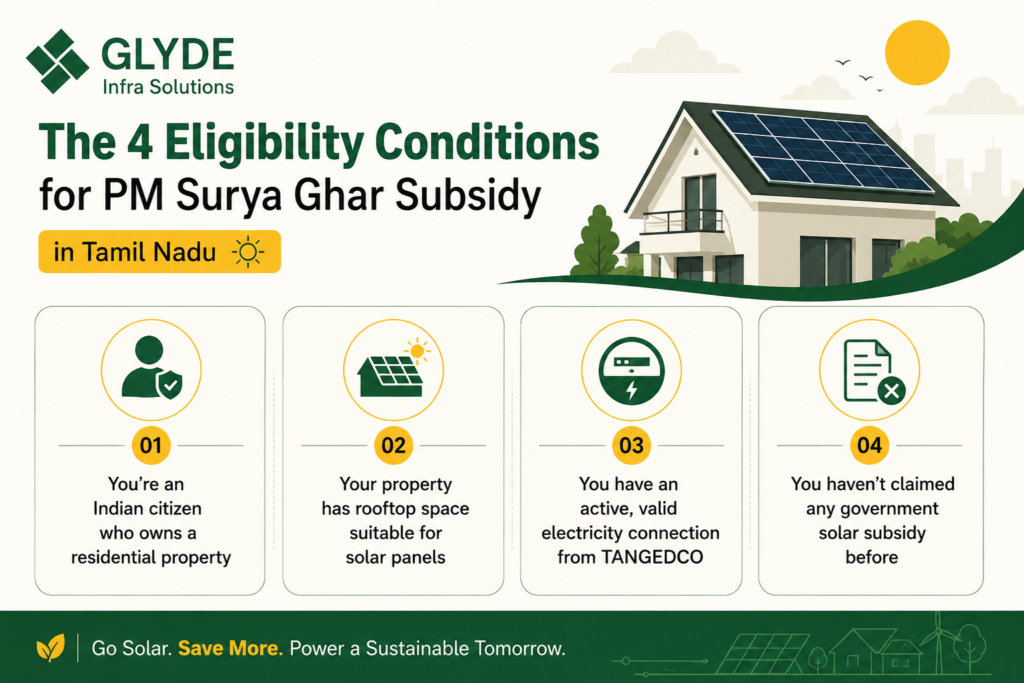
- You’re an Indian citizen who owns a residential property
- Your property has rooftop space suitable for solar panels
- You have an active, valid electricity connection from TANGEDCO
- You haven’t claimed any government solar subsidy before
Practical checks before you apply
A few things that trip people up after they think they qualify:
Tenants: You generally don’t qualify unless the installation is done in the property owner’s name with a long-term NOC. If you rent, get the owner involved before you start the process.
Electricity connection in someone else’s name: The subsidy is linked to your TANGEDCO consumer number. If the connection is in a family member’s name, get it transferred before applying. Applications with mismatched names get flagged.
Bank account: Your account must be Aadhaar-seeded for the Direct Benefit Transfer to go through. Check this before you apply, not after. An unseeded account means the subsidy has nowhere to land, regardless of how smoothly everything else goes.
Apartments and flats: Individual flat owners can’t apply independently unless they have a dedicated rooftop connection in their name. Housing societies and Resident Welfare Associations can apply collectively for common area installations. Check with your association before registering.
Previous subsidy claimants: If you claimed a government solar subsidy under any earlier scheme, including Phase II of the Grid-Connected Rooftop Solar Programme, you’re not eligible under PM Surya Ghar.
How to apply for PM Surya Ghar subsidy in Tamil Nadu
The application process runs entirely through pmsuryaghar.gov.in and involves six steps, from registering with your TANGEDCO consumer number to receiving the subsidy in your bank account. TANGEDCO handles feasibility approval, vendor selection, installation, net metering, and commissioning before the credit is triggered.
| Pro Tip: Wondering how to apply for a solar subsidy in Chennai? We’ve covered the full process in detail, including the exact documents you need, common rejection reasons, and how to follow up with TANGEDCO if your inspection is delayed. Read the complete step-by-step guide: How to apply for a solar subsidy in Chennai |
The PM Surya Ghar subsidy window is open. It won’t stay open forever
The PM Surya Ghar subsidy is confirmed, closing on 31 March 2027. The ₹78,000 is real, the free electricity is real, and the deadline is real.
For Chennai homeowners, the math is simple. A 3kW system at ₹1,18,000 after subsidy, a 4 to 5 year payback, and 20-plus years of free electricity after that. TANGEDCO tariffs will keep rising. Your solar savings compound every year they do.
The only thing that changes this calculation is waiting too long. TANGEDCO queues will get longer as March 2027 approaches. Empanelled vendors will get booked out. The homeowners who apply in January 2027 will be competing with everyone who procrastinated through 2026.
Start now. The process takes 60 to 90 days from registration to subsidy in your account. That’s the time you need to protect.
Get your PM Surya Ghar subsidy before March 2027
One call is all it takes to know exactly what system size you need, what it’ll cost after subsidy, and how quickly we can get you installed before the March 2027 deadline.
At Glyde Infra Solutions, we handle the entire process from portal registration to TANGEDCO approvals to subsidy claim.
📞 Call us: 7010021773
💬 WhatsApp us: 7010021773
Frequently asked questions about PM Surya Ghar subsidy ending in 2027
1. Is the PM Surya Ghar subsidy scheme really ending in March 2027?
Yes. The official pmsuryaghar.gov.in portal confirms it with a live countdown: “Scheme closes on 31 March 2027.” The ₹75,021 crore budget and the 1 crore installation target are both tied to that date. There’s no confirmed extension or replacement scheme announced as of July 2026.
2. What happens to my application if I apply now but the scheme closes before my installation is complete?
This is the most important question most people don’t ask. If you register before March 31, 2027, and receive your Letter of Intent from TANGEDCO, you’re in the system. Complete your installation and net metering before the deadline to ensure your subsidy claim is processed under the current scheme terms. Starting early gives you enough buffer for TANGEDCO processing delays.
3. Can I apply for PM Surya Ghar Muft Bijli Yojana if I live in a flat or apartment in Chennai?
Individual flat owners can’t apply independently unless the electricity connection is in their name with dedicated rooftop access. Housing societies and Resident Welfare Associations can apply collectively for common area installations. Check with your housing society before registering on the portal.
4. Does Tamil Nadu offer any additional state subsidy on top of the PM Surya Ghar central subsidy?
As of July 2026, Tamil Nadu doesn’t run a separate state-level residential rooftop solar subsidy on top of the central scheme. The ₹78,000 central subsidy is what’s available. Some other states, like Uttar Pradesh, offer additional top-ups, but Tamil Nadu homeowners currently get the central scheme only.
5. What happens if my vendor installs panels that aren’t ALMM List II compliant?
Your subsidy claim gets rejected at the commissioning stage. You lose ₹60,000 to ₹78,000 with no recourse after installation. From June 1, 2026, both the solar module and the cells inside it must be from MNRE-approved domestic manufacturers. Always verify your vendor’s panel compliance on the ALMM list before signing any agreement, not after.
Pingback: PM Surya Ghar Subsidy in Chennai: ₹78,000 Guide (2026)